
How to Plan a Corporate Office Renovation in NYC Without Disrupting Your Team
Your lease is up for renewal. Your office hasn't been touched in ten years. The layout no longer reflects how your team actually works. Or maybe you just secured a new space and need to build it out from scratch before move-in day.
Whatever the trigger, corporate office renovation in New York City is one of the most logistically complex projects a business can undertake. You're not just managing a construction project — you're managing it inside an active commercial building, in a city with some of the strictest building codes in the country, while simultaneously trying to keep your team productive and your operations running.
The good news is that with the right planning and the right contractor, an office renovation doesn't have to feel like a crisis. This guide walks you through everything you need to know — from the initial planning phase through final punch list — so your renovation delivers the workspace you envisioned without months of unnecessary chaos.
Start With a Clear Scope — Before You Call Anyone
The single biggest mistake businesses make when planning an office renovation is calling contractors before they have a defined scope of work. Without clarity on what you actually need, every contractor will bid a different project, you'll get wildly inconsistent proposals, and you'll waste weeks going back and forth on misaligned expectations.
Before you engage a contractor, get aligned internally on a few key questions:
What's driving this renovation? A new lease, a rebrand, headcount growth, or a return-to-office push all produce different renovation priorities.
How does your team actually use the space today — and how do you want them to use it after? Don't assume yesterday's layout is the right starting point.
What's the budget? Be honest with yourself here. Contractors can work within a range, but they need a real number to give you a realistic proposal, not a wish list.
What's the timeline? Is this driven by a lease date, a planned expansion, or a client presentation? Deadlines shape everything from contractor selection to permit strategy.
Do employees need to stay in the space during construction, or can you vacate? This single variable has enormous implications for sequencing, scheduling, and cost.
Once you have answers to these questions, you're ready to have a productive conversation with a contractor. Until then, you're just generating confusion.
Understand What NYC Permits Your Office Renovation Actually Requires
New York City's Department of Buildings (DOB) has specific permit requirements for commercial office renovations, and the scope of your project determines exactly what filings you'll need. Getting this wrong early creates delays that can push your move-in date back by months.
Alteration Type 2 (Alt-2)
Most meaningful office renovations — anything involving new partition walls, electrical upgrades, ceiling modifications, plumbing changes, or mechanical work — require an Alt-2 permit. This requires sealed drawings from a licensed Professional Engineer (PE) or Registered Architect (RA) and a full plan review by the DOB before construction can begin.
Standard Alt-2 plan review currently takes 10 to 20 business days for straightforward projects. If a DOB examiner has objections or requires revisions, add more time. Factor this into your project timeline from day one — most businesses underestimate it significantly.
Professional Certification Filing
If your architect or PE is eligible for Professional Certification (Pro-Cert) filing, they can certify code compliance directly, bypassing standard plan review. This can reduce approval time to 5 to 10 business days. It costs more in professional fees but is worth it on time-sensitive projects.
Cosmetic Work — What Doesn't Need a Permit
Purely cosmetic work — painting, flooring replacement (without structural changes), replacing light fixtures in kind — typically doesn't require a DOB permit. But the moment you touch electrical panels, add or move walls, modify the HVAC system, or make changes that affect the building's means of egress, you're in permit territory.
A good contractor will tell you upfront what requires permits and what doesn't. Be wary of contractors who suggest skipping permits on work that clearly needs them — in NYC, unpermitted work can result in violations, stop-work orders, and fines that far exceed whatever you saved.
Building Management Approvals
Separate from DOB permits, your building management or landlord will have their own approval process for renovation work. Most commercial landlords require submission of plans, proof of contractor insurance, and a pre-construction meeting before work can begin. Some buildings also require after-hours work for particularly disruptive activities like demolition or concrete cutting. Build these approvals into your timeline — they're not optional, and they're not always fast.

Plan the Work Around Your People — Not the Other Way Around
The question most office renovation guides skip is the most important one: when and how do your employees work? Because the answer shapes everything about how your renovation should be sequenced.
A law firm where attorneys bill hours from 8 AM to 8 PM has completely different renovation constraints than a tech company where most employees come in between 10 AM and 4 PM. An office with a large client-facing reception area needs that space protected during business hours. An office with a call center needs noise management above everything else.
Here are the strategies that work best for keeping teams operational during office renovations in NYC:
Zone-by-Zone Phasing
Rather than gutting the entire office at once, divide the renovation into zones — one section of the floor at a time. While Zone A is under construction, employees are temporarily relocated to Zone B. When Zone A is complete, the team moves in and Zone B construction begins.
This approach takes longer than a full gut renovation, but it keeps your team in the building and productive throughout. For businesses that cannot vacate, it's often the only viable path.
After-Hours and Weekend Construction
For high-disruption work — demolition, concrete cutting, ceiling demo — scheduling construction outside business hours dramatically reduces the impact on employees. Most NYC commercial buildings permit after-hours construction with prior approval from building management.
After-hours work costs more (overtime labor rates) but can compress the overall timeline and make the renovation nearly invisible to your team during business hours. For businesses with tight move-in deadlines, the premium is often worth it.
Temporary Space Planning
If the renovation scope requires full vacating of the office — or if you're building out a new space from scratch — work with a commercial real estate broker to identify temporary swing space. Many NYC buildings offer short-term furnished office suites on flexible leases specifically for this purpose. The cost is predictable and usually far lower than the productivity loss of employees trying to work through a full demolition.
Remote Work Periods
For companies with remote-capable workforces, designating specific construction phases as planned remote work periods is a legitimate strategy. Employees appreciate the transparency, avoid the disruption, and the construction team gets full site access. Coordinate this with HR and team leads well in advance — last-minute announcements create anxiety.
Dust Control: The Detail That Makes or Breaks Employee Relations
Ask any business owner who has tried to work through an office renovation and they will tell you the same thing: the dust was the worst part.
Construction dust is not like household dust. Demolition generates fine particulates that penetrate HVAC systems, settle on electronics, migrate under doors and through gaps in temporary walls, and create genuine air quality issues for employees with respiratory conditions. Managing dust is not a courtesy — it is a core professional responsibility.
Here is what rigorous dust control looks like in an occupied commercial office:
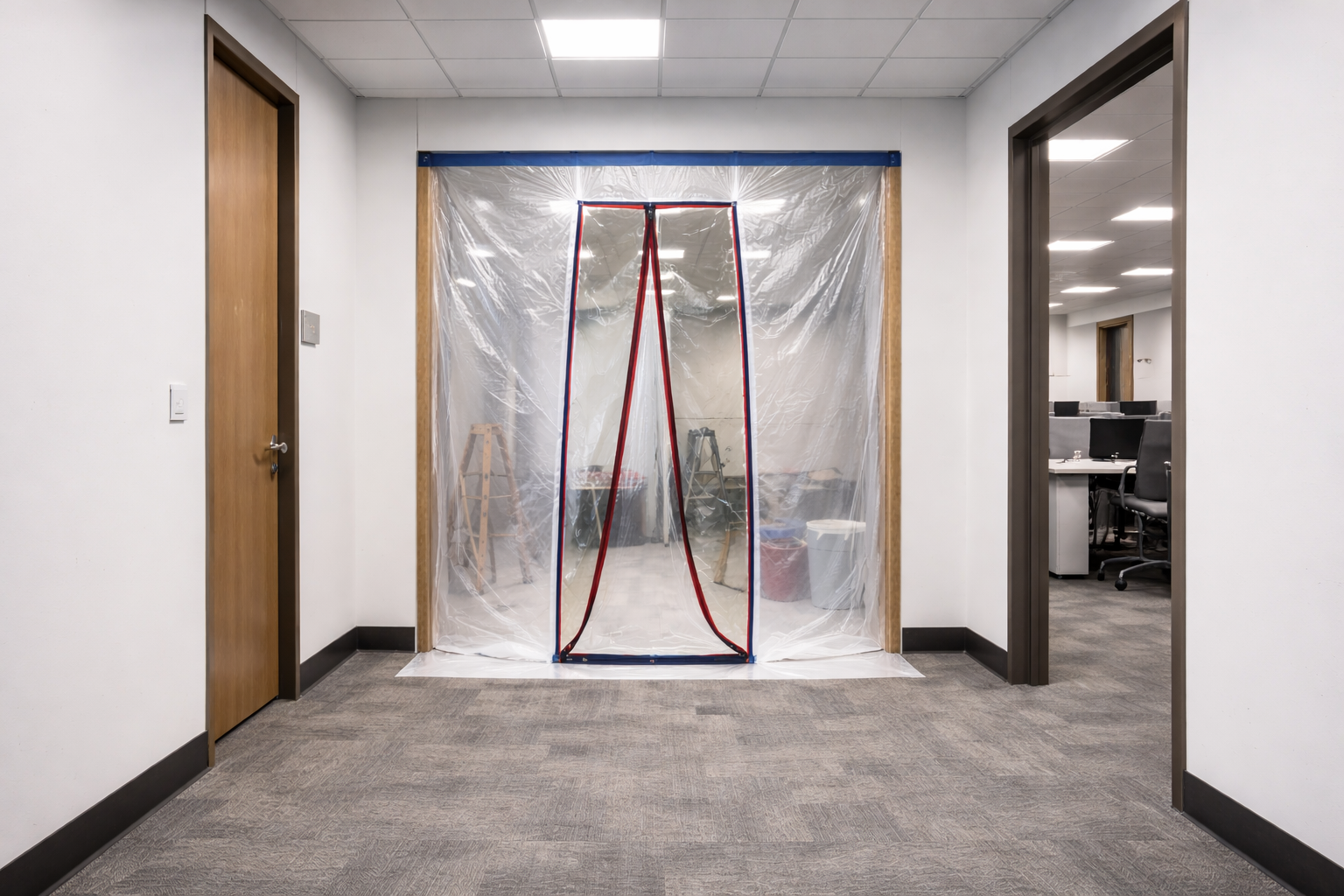
Floor-to-ceiling temporary barriers with zipper access doors, installed at both ends of the work zone, creating a sealed construction envelope.
HEPA-filtered negative air machines running inside the construction zone, creating negative pressure that draws air inward rather than pushing dust outward into the occupied space.
HEPA vacuum attachment on all demo tools — grinders, sanders, drills — capturing dust at the source before it becomes airborne.
Protective covering on HVAC vents within and adjacent to the work zone to prevent dust infiltration into the building's air distribution system.
Daily cleanup at the end of every shift, before employees arrive the next morning. Not weekly. Daily.
Hard surface floors in adjacent areas wiped down and vacuumed every evening. Carpeted areas in the surrounding zone vacuumed every day.
When evaluating contractors, ask specifically how they handle dust control in occupied commercial offices. A contractor with real experience in this environment will give you a detailed, specific answer. A contractor without it will give you a vague one.
Noise Management in NYC Office Buildings
Noise is the other variable that determines whether your renovation is a minor inconvenience or a month-long productivity disaster. And in New York City commercial buildings, where your renovation may be on floor 12 of a 30-story building with other tenants above, below, and beside you, noise management requires active planning — not just hoping for the best.
Know Your Building's Rules
Every commercial building in NYC has its own rules governing construction hours and noise restrictions. These rules are set by the landlord or building management and are typically outlined in your lease and in the building's house rules for contractors. Before any work begins, confirm exactly what is permitted: which hours, which days, and what activities (if any) require after-hours scheduling.
Violations of building construction rules can result in your contractor being removed from the site — a scenario that is as disruptive as anything the renovation itself would create.
Notify Affected Floors in Advance
If your renovation involves particularly loud work — demo, core drilling, concrete sawing — give neighboring tenants advance notice through building management. A brief notice explaining the scope, dates, and anticipated noise level goes a long way toward preserving goodwill. Surprises create complaints. Advance notice creates understanding.
Schedule Loud Work Strategically
The loudest work can almost always be concentrated into specific time windows rather than spread throughout the day. Demolition scheduled for two intensive days rather than scattered over two weeks is better for everyone. A competent contractor will sequence the work to front-load the disruptive activities and transition to quieter finish work as quickly as possible.
Communicate With Your Own Team
Your employees need predictability, not perfection. A heads-up that says 'On Tuesday and Wednesday, there will be loud demolition work from 9 to 11 AM in the east wing' gives people the ability to schedule important calls or client meetings around the disruption. Employees who are caught off guard by unexpected noise become frustrated employees. Employees who were warned are generally understanding.
Choosing the Right Layout: Open Plan, Private Offices, or Hybrid
The layout question is the one most office renovation projects get wrong — not because people make bad decisions, but because they make decisions based on trends rather than how their specific team actually works.
The Open Plan Myth
Open-plan offices became the dominant corporate design philosophy through the 2010s, driven by tech companies and the promise of spontaneous collaboration. A decade of data has complicated that story considerably. Open plans reduce individual focus time, increase noise-related stress, and can actually decrease collaboration by removing the private spaces where substantive conversations happen.
That doesn't mean open plans are wrong — but it means the decision should be made based on your team's work style, not a floor plan trend from 2015.
Private Offices for Deep Work
If your team does significant heads-down, focused work — legal analysis, financial modeling, software development, writing — private offices or enclosed focus rooms deliver real productivity value. The cost premium of enclosed offices over open workstations is real, but so is the productivity gain for knowledge workers who need concentration time.
The Hybrid Approach
Most modern NYC office renovations land on some version of a hybrid model: an open collaborative core with dedicated enclosed conference rooms, private focus rooms, and quiet zones for concentration work. This approach gives teams the flexibility to choose their environment based on what they're doing, rather than forcing everyone into one mode.
When planning your layout, spend real time observing how your team actually behaves. Where do they congregate for spontaneous conversations? Where do they go when they need to concentrate? Where do client-facing meetings happen? The answers should drive the design — not the other way around.
Selecting Materials That Work in a Commercial NYC Office
Material selection in a corporate office renovation is not primarily an aesthetic decision — it is a performance decision. The materials you choose will be subjected to heavy daily use, and the difference between commercial-grade and residential-grade products becomes visible within the first year.
Flooring
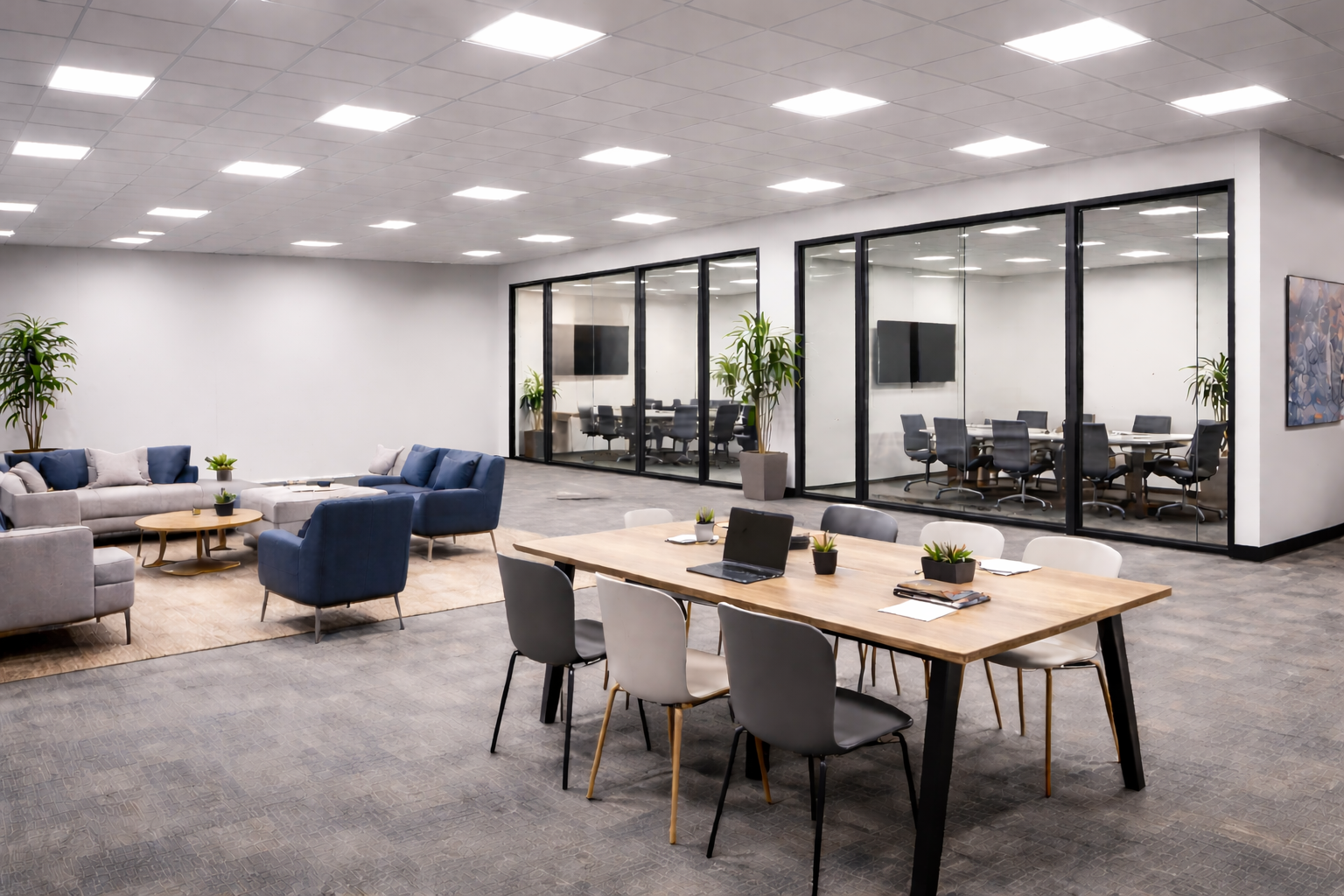
Commercial carpet tile is the most popular choice for NYC office environments, for good reason. It absorbs sound, reduces foot fatigue, and allows individual tile replacement when sections are damaged or stained — without replacing the entire floor. Modern commercial carpet tile products carry strong stain resistance warranties and can last 10 to 15 years with proper maintenance.
Luxury vinyl plank (LVP) or luxury vinyl tile (LVT) is increasingly common in reception areas, break rooms, and circulation areas. Commercial-grade LVT is extremely durable, waterproof, easy to maintain, and available in realistic wood and stone appearances. For reception areas where first impressions matter, it provides a polished, professional look at a lower cost than real stone.
Walls and Ceilings
Commercial paint formulations designed for high-traffic environments offer significantly better scrub resistance and durability than standard paint. In corridors, reception areas, and conference rooms — spaces that see constant contact from chairs, bags, and equipment — commercial paint pays for itself in reduced maintenance.
Drop ceiling systems (acoustic tile in metal grid) remain the standard for most corporate offices because they provide easy access to building mechanical systems above — critical in NYC buildings where your HVAC, electrical, and data infrastructure runs through the ceiling plenum. The aesthetic has evolved considerably; modern acoustic tile products are sleek and professional, not the yellow-stained grid ceilings of the 1980s.
Lighting
LED lighting is not optional in any modern office renovation — it is the baseline. LED fixtures deliver dramatically lower energy costs, 50,000 to 100,000 hours of rated life, and light quality that supports employee wellbeing and productivity. The upfront cost premium over fluorescent is offset many times over by reduced energy bills and virtually eliminated maintenance over the fixture's lifespan.
Color temperature matters in office environments. Neutral white (3500K to 4000K) is the standard for general office lighting — it feels clean and professional without the harsh blue tones of cool white or the dim warmth of residential lighting. Tunable LED systems, which can shift color temperature throughout the day to support circadian rhythms, are gaining traction in higher-end office renovations.
The Timeline Reality: How Long Does a NYC Office Renovation Actually Take?
Timeline is the area where expectations diverge most dramatically from reality in NYC office renovation projects. Here is an honest breakdown by renovation type:
Cosmetic Refresh (Paint, Flooring, Lighting)
For purely cosmetic work in a space that does not require DOB permits, a competent contractor can complete a typical 3,000 to 5,000 square foot office in 2 to 4 weeks. Add permit time if any of the work falls into permit-required territory, and add time for phasing if the space is occupied.
Mid-Level Renovation (Reconfiguration, New Finishes, Electrical Updates)
A meaningful renovation that includes new partition walls, electrical work, ceiling modifications, and upgraded finishes typically takes 6 to 12 weeks from permit approval to completion. Factor in 3 to 6 weeks of permit review time before construction even begins. Total elapsed time from contract signing to move-in: 3 to 5 months.
Full Buildout (Raw Space or Complete Gut Renovation)
A full office buildout from raw space — framing, MEP rough-ins, drywall, ceilings, flooring, lighting, finishes — typically takes 12 to 20 weeks of construction. Add permit time and design time, and you are looking at 5 to 8 months from project initiation to occupancy. Plan accordingly and build realistic buffers into your lease commencement timeline.
The Hidden Timeline Killer: Existing Conditions
In older NYC office buildings — and most Manhattan office stock is older — concealed existing conditions are the most common source of timeline delays. Outdated wiring that requires full replacement instead of partial upgrade. Structural elements in unexpected locations that change the partition layout. Asbestos-containing materials discovered during demolition that require abatement before construction can proceed.
An experienced contractor will identify probable hidden conditions during the pre-construction walkthrough and build contingencies into the schedule. Inexperienced contractors give you a schedule built on best-case assumptions and then ask for extensions when reality arrives.
How to Evaluate and Select the Right Office Renovation Contractor in NYC
Contractor selection is the decision that determines whether your renovation is a smooth, professional experience or a prolonged ordeal. In a market as competitive and complex as New York City, the difference between experienced commercial contractors and those who have primarily done residential or out-of-market work is significant.
Verify Licenses and Insurance — In Writing
Any contractor doing commercial work in NYC should hold a NYC Home Improvement License (issued by the Department of Consumer Affairs) and a DOB General Contractor License for permit-required work. Verify both — do not take the contractor's word for it. Request certificates of insurance showing general liability coverage (at minimum $2 million per occurrence), workers' compensation, and automobile coverage. Require that your company and building be named as additional insured on their policy.
Look for NYC Commercial Experience — Not Just Renovation Experience
A contractor with ten years of experience renovating residential apartments is not the same as a contractor with ten years of commercial office renovation experience in NYC. The permit processes, building management relationships, material specifications, and occupied-building protocols are different. Ask specifically about their commercial office portfolio and ask for references from business owners or office managers at companies similar to yours.
Ask the Right Questions in Your Initial Meeting
The questions you ask a contractor in the initial meeting tell you as much as their answers. Ask: How do you handle dust control in occupied offices? What is your approach to after-hours scheduling? How do you manage communication with building management? What happens if you discover unexpected conditions during demolition?
A contractor with real commercial NYC experience will answer these questions specifically and confidently. A contractor who is new to this environment will give you vague reassurances. Trust the specificity of the answers, not the enthusiasm.
Get Detailed, Itemized Proposals — Not Lump Sums
A detailed proposal that itemizes scope, materials, labor, and allowances tells you two things: the contractor understands your project, and you have a clear basis for comparison. A lump-sum proposal with minimal detail tells you neither. Always get at least two or three proposals from qualified contractors, and compare them at the line-item level — not just the bottom line.
Corporate Office Renovation Costs in NYC: What to Budget
Cost transparency is important, so here are honest benchmarks for corporate office renovation in New York City. These ranges reflect current labor and material costs and typical NYC building conditions:
Cosmetic Refresh
New paint, flooring replacement, lighting upgrades, and minor repairs. Typical range: $15 to $25 per square foot. A 3,000 square foot office would cost $45,000 to $75,000 for a professional-quality cosmetic update.
Mid-Level Renovation
Reconfigured layout with new partition walls, upgraded finishes throughout, electrical and lighting overhaul, and new ceilings where needed. Typical range: $40 to $75 per square foot. A 3,000 square foot office would cost $120,000 to $225,000.
Full Office Buildout
Complete tenant buildout from raw or gutted space, including all MEP rough-ins, framing, drywall, ceilings, flooring, lighting, painting, millwork, and finish hardware. Typical range: $80 to $150 per square foot in NYC. A 3,000 square foot buildout would cost $240,000 to $450,000 depending on finish level and mechanical complexity.
Budget for Contingency
In NYC office buildings — particularly buildings constructed before 1980 — always budget a contingency of 15 to 20 percent above your base estimate. Unexpected conditions are common, and a contingency budget protects you from the cash-flow crisis of a significant change order with no reserve to cover it.
Every office renovation is different, and these ranges are starting points — not guarantees. A detailed proposal from an experienced contractor, based on an actual site walkthrough and assessment of existing conditions, is the only reliable basis for your budget.
Request a Free Estimate for Your NYC Office Renovation
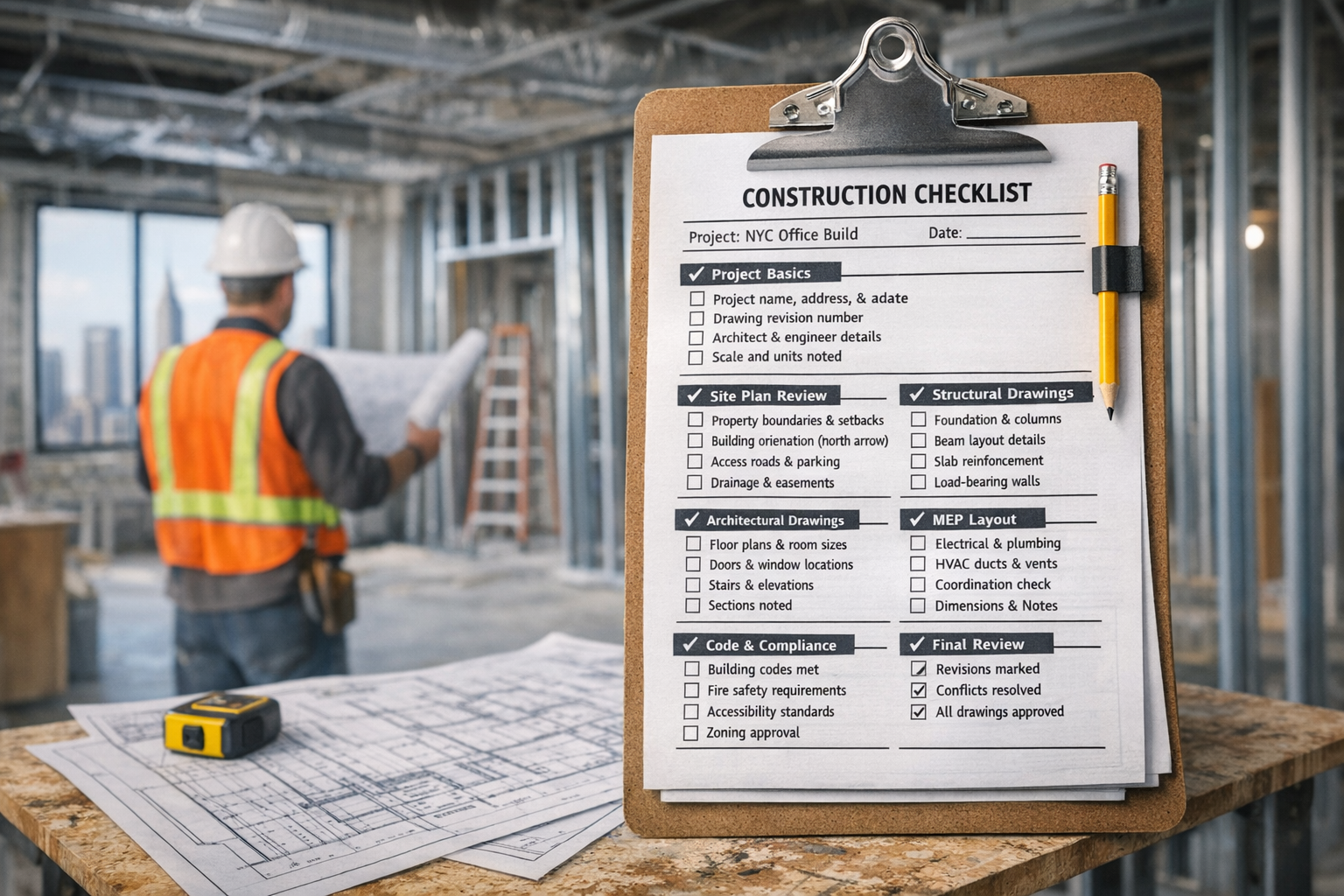
A Practical Pre-Construction Checklist for NYC Office Renovations
Before construction begins, run through this checklist to confirm you are set up for a smooth project:
Scope of work is defined and agreed upon in writing by all internal stakeholders.
Budget is approved, including contingency.
Contractor is selected, licensed, insured, and under contract.
Architect or PE is engaged if DOB permits are required.
DOB permit application is filed — and timeline accounts for review period.
Building management has approved contractor, reviewed plans, and confirmed work hours.
Employee communication plan is in place: who will be notified, when, and through what channel.
Phasing plan is confirmed if the space will remain occupied during construction.
Temporary work arrangements are arranged for employees affected by each phase.
Pre-construction photos and video of existing conditions have been documented.
Material submittals have been reviewed and approved in writing.
Project manager contact information is shared with your internal point person.
Ready to Plan Your NYC Office Renovation?
A well-planned office renovation is one of the most valuable investments a New York City business can make. The right space attracts and retains talent, signals professionalism to clients, and creates an environment where your team does its best work. Done right, the disruption is temporary and manageable. Done wrong, it is months of frustration that follows you long after the project ends.
The difference between those two outcomes comes down to planning, contractor selection, and proactive communication — with your team, your building, and the people doing the work.
NYC Remodeler Inc. specializes in corporate office renovation across Manhattan and Westchester County. We hold a NYC Home Improvement License (#2110887-DCA) and NYC DOB General Contractor License (#GC-623025), carry full insurance, and are EPA certified. Every project comes with a dedicated project manager, transparent pricing, comprehensive dust control, and the experience of working in occupied commercial buildings throughout New York City.
If you are planning an office renovation, we would be glad to walk through your space, discuss your goals, and provide a detailed, no-obligation estimate.
Call us at (347) 361-6641 or complete our online form. We serve Manhattan and Westchester County.
